
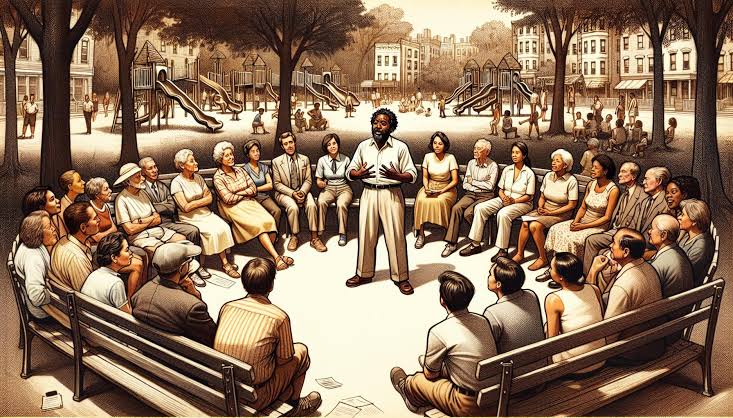


The strongest leaders are not the ones who move fastest. They are the ones capable of asking, before every major decision, what an institution or a country will actually be standing on fifty years from now if this choice is made today — a question almost entirely absent from quarterly reporting cycles and election cycles alike.
That absence is not a minor gap. Most leadership conversations, in a boardroom or a government office, are optimized for the timescale of a single news cycle: how this looks tomorrow, how this quarter compares to the last, which stakeholder needs reassurance by Friday. None of that is unreasonable on its own terms. Leaders who ignore immediate pressure do not survive long enough to worry about longer horizons. But civilisational leadership operates on a different clock entirely, and that clock rarely gets a hearing in rooms built to reward speed.
The phrase itself invites skepticism, and rightly so — leadership that considers itself historically significant is usually a warning sign, not a virtue. The discipline meant here is narrower and less flattering to the person practicing it: a willingness to translate between institutions that move fast and institutions built, by design, to move slowly — without letting either dominate the other. Move too quickly, and trust built over generations erodes in a fiscal quarter. Move too slowly, and a genuine window for transformation closes before anyone acts on it.
Nowhere is this tension sharper than in development work across India's northeastern states, where welfare delivery, indigenous rights, and rapid infrastructure investment collide with histories and relationships to land that long predate any current policy framework. A program designed purely on an urgency timeline — deliver the target, move to the next region — can do lasting damage to communities whose governance of themselves cannot simply be optimized around. Civilisational leadership here means slowing down long enough to understand what already exists before deciding what to build atop it. It is a slower, less photogenic kind of leadership than the version that produces a satisfying press release. It is also the only kind still generating gratitude a generation later.
Artificial intelligence sharpens this question rather than resolving it, because AI is a technology built, almost by design, for the fastest possible timescale — faster iteration, faster deployment, faster returns. Civilisational leadership in the AI era means being willing to ask whether a capability that can be deployed this quarter should be deployed this quarter, or whether the institutions meant to govern its consequences need more time to develop the judgment the moment requires. That is an unpopular position in rooms rewarded for speed. It is worth holding anyway.
None of this is an argument for treating every inherited institution as sacred, or every established tradition as beyond challenge. Plenty of both deserve to be dismantled. Civilisational leadership is not conservatism in more flattering language — it is the discipline of asking, without self-flattery, which parts of the present are load-bearing and which are merely inherited, and having the patience to tell the difference before demolishing or rebuilding either one.
The urgent and the enduring rarely agree on a timeline. Civilisational leadership is choosing, deliberately and repeatedly, which one gets the final word — rather than letting the loudest deadline in the room make that choice by default.